Departure flights cancelled at Schiphol airport. Photo by Dan.
It is amazing how your life changes when your are an expat. Suddenly you travel a lot and as most of your friends are expats... they also travel a lot. Then your agenda becomes a complex world of knowing where everybody is, when they are coming back, whether you will be in The Netherlands or Spain for this Birthday, this gathering, this farewell party.
This kind of nomadic lifestyle leads to the fact that around 95% of the people I met during the last few years have been affected, to a different extent, by the unpronounceable Icelandic volcano:
- I had to travel to Berlin (business trip, international Symposium) but of course, it was not possible and my company arranged a bus for everybody. 10 hours to get to Berlin instead of 1 hour 15 minutes. However, at the end the whole event was cancelled. People from Canada, USA, Japan and Russia couldn't get there either... so there was no point. Some of my colleagues went to Berlin by train hoping to come back by plane... but they are either trapped there or condemned to another 7-hour trip back to Amsterdam.
- Daniel had to go to Madrid... but he gave up after rescheduling for the fifth time!! and being on hold on the phone with KLM for ages.
- Our friend Baran made a trip Amsterdam-Paris-Amsterdam in one day to rescue one friend.
- Jackie is trapped in the UK with her parents stranded in Spain.
- Our friend Eduardo was also due to fly from the UK to Spain... but again, it was impossible.
- Other people we know had to take a bus from Amsterdam to Toulouse, others are a bit luckier and can go by car to the close Belgium.
And what about you? Have you been affected by the ash cloud??? Come on, have your say... prove me that someone is still reading this blog :-)
Es asombroso cómo tu vida cambia cuando eres un expat. De repente pasas a viajar mucho y la mayoría de tus amigos son expats ... por lo que también viajan mucho. Tu agenda es un complejo caos en el que tienes que saber donde está todo el mundo, cuándo vuelven, y si tú vas a estar en Holanda o en España para tal o cual cumpleaños, reunión o fiesta de despedida.
Este estilo de vida cuasi nómada lleva al hecho de que cerca del 95% de las personas que he conocido durante los últimos años se han visto afectadas, en distinta medida, por el volcán islandés de nombre impronunciable:- En teoría yo tenía que viajar a Berlín (viaje de negocios, Simposio Internacional) pero por supuesto no fue posible y mi empresa organizó un autobús para todo el mundo. 10 horas para llegar a Berlín, en vez de 1 hora y 15 minutos. Sin embargo, al final todo el evento fue cancelado. La gente de Canadá, EE.UU., Japón y Rusia no podía llegar allí ... asi que no tenía sentido. Algunos de mis colegas fueron a Berlín en tren con la esperanza de volver en avión y ahora o se quedan allí atrapados... o tendrán que volver a sufrir 7 horas en tren a Amsterdam.
- Dani tenía que ir a Madrid ... pero se dio por vencido después de cambiar su vuelo por quinta vez! y de estar en espera al teléfono con KLM durante horas.
- Nuestro amigo Baran tuvo que hacer Amsterdam-París-Amsterdam en un día para rescatar a una amiga.
- Jackie se encuentra atrapada en el Reino Unido con sus padres varados en España.
- Nuestro amigo Eduardo también tenía que volar desde el Reino Unido a España ... pero, una vez más, fue imposible.
- Otras personas que conocemos tuvieron que coger un autobús desde Amsterdam a Toulouse, otros tienen un poco más suerte y pueden ir en coche a la cercana Bélgica.
¿Y tú? ¿Te ha afectado la nube volcánica??? Vamos, decid algo ... demostradme que alguien sigue leyendo este blog :-)

Today it's been 3 years since we arrived to The Netherlands and it seems like it is time to make an assessment of all this period.
If I look back I don't regret the decision of leaving Spain at all. I had a comfortable life, a good job with a good salary (in terms of salaries in Spain) and a favorable future ahead... but having such a conventional life and that certain future has always scared the hell out of me so I wanted a change, something different, even difficult, which required effort and made me feel proud of my achievements. In short, a challenge.
After settling down, which was not easy (living in a bed&breakfast while looking for a house... then living without furniture for some time) we started a very busy life. I had to attend to the University, study and work, at the same time, for a Spanish company, which is not the ideal for starting a "new" life abroad but I needed the money and that was the only option at that time. Fortunately, last year has been a bit more different and specially the last months, since which I work for an international organization and I am starting to build a new network of friends from everywhere in the world.
I find that life in The Netherlands is quite relaxed compared to life in Spain, not only due to the different timetables and habits but also because I have less social engagements given that my family is a bit far from here. Though I like that feeling, sometimes I feel like an alien, alone, like I don't belong here but I don't belong there either... it's a weird combination that, apparently, is not that uncommon among people living abroad. Dave Hampton pointed out this article written in the Economist where all these feelings are quite well reflected.
Anyway, I am looking to the future with a positive attitude. Suddenly this adventure does not seem as temporary as it might be and I have a life that I like here. Maybe the time has come to finally learn some Dutch :-)
Hoy hace 3 años que llegamos a Holanda y es, por tanto, un buen momento para hacer balance de este periodo.
Mirando atrás no lamento en absoluto la decisión de salir de España. Tenía una vida confortable, un buen trabajo con un buen sueldo (de acuerdo a los sueldos españoles) y un futuro favorable por delante... pero llevar una vida tan convencional y tener un futuro tan estudiado siempre me ha asustado bastante así que necesitaba un cambio, algo diferente, incluso difícil, que requiriese esfuerzo y me hiciera sentir orgullosa de lo logrado. En definitiva, un reto.
Después de asentarnos, lo que no fué fácil (viviendo al principio en un bed&breakfast mientras buscábamos una casa... y luego viviendo sin muebles por algún tiempo) empezamos una vida bastante ocupada. Yo tenía que ir a la Universidad, estudiar y al mismo tiempo trabajar para una empresa española, lo cual no es la opción más acertada para empezar una "nueva" vida en el extranjero pero había que ganar dinero y esa era la única opción en ese momento. Afortunadamente, el año pasado ha sido bastante mejor, sobre todo los últimos meses en los que he empezado a trabajar para una organización internacional y estoy conociendo a mucha gente de todas partes.
La vida en Holanda me resulta bastante más relajada que la vida en España y no sólo por lo que me afecta respecto a horarios y costumbres, sino también porque aquí tengo muchos menos compromisos sociales ya que mi familia está bastante lejos. Aunque esta sensación me gusta bastante, también siento a veces que soy una extraña, que estoy sola, que no pertenezco ni a aquí ni a allí... es una combinación rara que por lo visto no es tan peculiar entre la gente que vive en el extranjero. Dave Hampton destaca este artículo escrito en The Economist y en el explican todos estos sentimientos bastante bien.
De todas formas, miro al futuro con optimismo. De repente esta aventura no parece tan pasajera como podría ser y tengo una vida que me gusta aquí. A lo mejor hasta ha llegado el momento de aprender holandés :-)
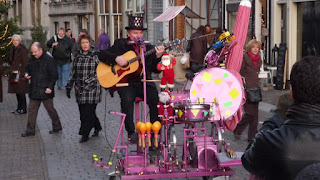
One-man band at Dordrecht Xmas Market
Christmas markets are very famous specially in Germany but also in The Netherlands. Though the most famous is close to Maastricht, we didn't have enough time to drive there so we decided to go to the second most famous Christmas market which is in the town of Dordrecht.
Dordrecht's Xmas market is open only for one weekend and there you can find the typical Xmas stalls selling all kind of decorations and also the typical food and drinks of these days like Glüwein, Poffertjes and hot chocolate.
The streets were completely crowded which is unusual for any place in The Netherlands and given also the low temperatures of this weekend!. Anyway, it is always nice to see some festive atmosphere!!!
P.S. I am very happy to announce that this is "SomosunoenHolanda" post number 100!!!!
Los mercados navideños son muy famosos en Alemania pero también en Holanda. Aunque el más famoso está cerca de Maastricht, no teníamos tiempo de ir hasta allí así que decidimos ir al segundo más famoso que está en la ciudad de Dordrecht.
El mercado de Navidad de Dordrecht sólo abre un fin de semana al año y se pueden encontrar los típicos puestos navideños donde comprar decoración y también todo tipo de comida y bebida típicas de estas fechas como el Glüwein, los Poffertjes y el chocolate caliente.
Las calles estaban abarrotadas de gente lo que es muy raro de encontrar por estos lares y encima dadas las bajas temperaturas de este fin de semana. De todas formas, siempre es estupendo poder disfrutar de ¡este ambiente festivo!
P.D.: Estoy muy feliz de anunciaros que ¡¡éste es el post número de 100 de "SomosunoenHolanda"!!

Spain is the country with the highest unemployment rate within the Euro area (19.3%) while The Netherlands has an unemployment rate of only 3.6% (source: Eurostat). Given these facts one can think that it would be easier to find a job in The Netherlands and I agree with that. The only problem is that you need to be fluent in either Dutch or English.
I have read some articles explaining that Spain would get over this crisis if their citizens emigrated. There are too many people and few jobs for them. My generation is one of the most prepared and educated, nevertheless they are offered poor jobs. Besides the language issue, most of the Spanish citizens have mortgages to pay and a family to maintain, so not all of them can just leave everything behind and move to another country. Young people, with no attachments yet, could have a better chance to escape from this economic holocaust if they moved abroad. The question is: are they willing to accept this challenge?
España es el país con mayor tasa de desempleo en la zona euro (19,3%) mientras que Holanda tiene una tasa de desempleo de sólo el 3,6% (fuente: Eurostat). Ante estos hechos se puede pensar que es más fácil encontrar un trabajo en los Países Bajos y estoy de acuerdo con eso. El único problema es que se tiene que dominar el inglés o el holandés.
He leído algunos artículos que explican que España superaría esta crisis si sus ciudadanos emigraran. Hay demasiada gente y pocos puestos de trabajo para ellos. Mi generación es una de los más preparadas y formadas a la que, sin embargo, se le ofrece puestos de trabajo de baja categoría. Además de la cuestión del idioma, la mayoría de los ciudadanos españoles tienen hipotecas que pagar y una familia que mantener, lo que no todos ellos pueden dejar todo atrás y trasladarse a otro país. Los jóvenes, sin ataduras aún, sí podrían tener una mejor oportunidad de escapar de este holocausto económico si se fueran al extranjero. La pregunta es: ¿están dispuestos a aceptar este desafío?

It is time to dedicate a post to this marvelous vehicle that invades Dutch streets. One can see bicycles of any style, size and color and they are driven by a wide spectrum of people. It does not matter whether you are a grandmother, a business man or a mother of three... you can always fit all your things (and also the kids!) in your bike. You can decorate it and customize it as much as you want. The picture above shows an "omafiets" (literally "grandma bike", the most common type of bike here) which has been pimped out with a bright color (probably to find it better and/or to avoid being stolen).
Bikes do not have a recreational use as they do in Spain, they are the most important means of transportation here. Commuting to work can be a pleasant experience compared to being stuck at a traffic jam or waiting for the bus or the train to come. After a few years living here, I really value the benefits of having bike paths everywhere. I usually go by bike to the train station and to the gym. It could take double time (or even more) to get to those places just walking and they are not far enough to go by car... so it's the perfect distance for a ride in my bike!
Ya es hora de dedicar un post al maravilloso vehículo que invade las calles de Holanda. Se pueden ver bicicletas de todos los estilos, tamaños y colores, y están conducidas por un variado espectro de gente. No importa si eres una abuela, un hombre de negocios o una madre de tres niños... siempre puedes meter todas tus cosas (¡incluso los niños!) en tu bici. También la puedes decorar y personalizar tanto como quieras. La foto de arriba muestra una típica "omafiets" (significa "bici de la abuela" y es el estilo de bici más común por aquí) que ha sido pintada de rosa (probablemente para encontrarla mejor y/o para evitar que sea robada).
Las bicis no son para uso recreativo, como lo son en España, sino que son el medio de transporte más importante aquí. Ir al trabajo puede convertirse en una experiencia placentera, comparada con estar atascado con el coche o esperando el bus o el tren. Después de unos años viviendo aquí, he aprendido a valorar las ventajas de tener carriles-bici por todas partes. Yo suelo ir al gimnasio y a la estación de tren en bici porque me llevaría más del doble ir andando y porque, por otro lado, están demasiado cerca para ir en coche... así que ¡es la distancia perfecta para un paseo en bici!

Maximum darkness we can achieve here. Photo by scataudo
Spaniards living in Holland miss something very important when they wake up in the morning: window blinds. The Netherlands might not be a sunny country, but the light here is pretty incredible. There is a myth that the light in Holland is different from anywhere else. This is probably caused by the permanent humidity, even if it is not raining. Painters and writers have been fascinated by the Dutch light for decades.
Houses here do not come with exterior blinds already installed as in Spain. Though we have been trying to adapt and get used to the light in the morning, it is hard... specially on weekends, when you always want to sleep a little bit more :-). If you live in a rented house like us, you cannot install exterior blinds so we tried to block the light with venetian blinds but, as you can see in the picture, they are not very effective. Then, the only solution to prevent the light from waking you up in the morning is to have blackout curtains and they have to be very well installed to block the light completely, so we are still working on that.
Anyhow, this makes me think about what is natural and what is not. It would be more natural to wake up with morning light instead of forcing our body to follow artificial schedules. Unfortunately we are already spoiled... but our children can still be saved!!! :-D
Los españoles que viven en Holanda echan de menos algo muy importante cuando se levantan por la mañana: las persianas. Holanda puede que no sea un país muy soleado, pero la luz aquí es increíble. Existe un viejo mito de que la luz en Holanda es diferente a la de cualquier otro lugar. Probablemente se debe a la humedad permanente, incluso cuando no llueve. La luz en Holanda ha sido objeto de fascinación durante décadas para muchos pintores y escritores.
En Holanda, las casas no tienen las persianas exteriores ya instaladas como en España. Aunque hemos intentado adaptarnos y acostumbrarnos a la luz, es duro... especialmente los fines de semana cuando siempre se quiere dormir un poquito más :-). Si vives en una casa de alquiler, como nosotros, no puedes instalar persianas exteriores así que intentamos bloquear la luz con persianas venecianas pero, como podéis ver en la foto, no es muy efectivo. La única solución para evitar que la luz te despierte por la mañana es poner cortinas tipo "foscurit" y tienen que estar muy bien instaladas para que bloqueen al 100%, así que aún seguimos trabajando en ello.
De todas maneras, esto me hace pensar en lo que es natural y lo que no lo es. Sería más natural despertarse con la luz del día y no forzarnos a seguir horarios artificiales. Por desgracia nosotros ya estamos echados a perder... pero nuestros hijos aún pueden salvarse!!! :-D

If you are thinking about coming to The Netherlands and you wonder what if you don't know Dutch, I can tell you that's not a big problem here. No doubt it would be better if you knew some Dutch because your job options would be less limited, but you can survive and do quite well with just English.
I have to be grateful for all the understanding coming from Dutch people when you say that you can't speak any Dutch. They switch to English without even blinking. Clerks at the supermarket, bus drivers, real state agents, dry cleaners, train ticket inspectors... they all can speak English here, and most of them have a very good level. You can do the experiment yourself. If you come to The Netherlands, pick up one random passerby in the street and ask for an address in English, they will help you for sure. Now, try and do that in Spain... unfortunately our English level is far from that.
Regardless the aforementioned, I would love to learn some Dutch. Being able to speak the official language of the country you live in matters if you really want to be integrated. If only it was less difficult!
Si estás pensando en venir a Holanda y te preguntas si pasa algo por no saber holandés, puedo decirte que no es un gran problema. Sin duda, sería mucho mejor si supieras algo de holandés ya que entonces tus opciones de encontrar un trabajo aquí estarían menos limitadas, pero se puede sobrevivir e incluso irte bastante bien sólo con inglés.
Agradezco muchísimo la compresión de los holandeses cuando dices que no eres capaz de hablar holandés. Cambian a inglés sin apenas pestañear. Los dependientes de los supermercados, los conductores de autobuses, los agentes inmobiliarios, los de la tintorería, los revisores del tren... todo el mundo habla inglés y la gran mayoría con un buen nivel. Puedes hacer el experimento tú mismo. Si vienes a Holanda, escoge a cualquier transeúnte por la calle y pregúntale por una dirección en inglés, te ayudará seguro. Ahora intenta hacer eso en España... por desgracia nuestro nivel de inglés no es tan bueno.
A pesar de esto, a mí me encantaría aprender holandés. Ser capaz de hablar el idioma del país en el que vives importa si realmente quieres integrarte. ¡Ojalá no fuera tan difícil!

When I was a child I used to have "pan con chocolate" (bread & chocolate) for "merienda" (the Spanish name for the afternoon snack after the midday lunch and before the late dinner). It was just a thick slice of french bread with a large piece of chocolate bar inside. It is probably the simplest combination, yet it was delicious.
I have discovered that here in The Netherlands they've taken this "delicatessen" :-) to a more sophisticated level. They take a slice of sandwich bread, spread butter on it and cover it with chocolate sprinkles. I am not sure though, if they have this for "merienda" or for breakfast. Dutch community, feel free to enlighten us!
Cuando era pequeña solía tomar pan con chocolate para merendar. Los españoles sabrán a lo que me refiero... unas cuantas onzas de chocolate metidas en un trozo de pan. No hay combinación más sencilla y a la vez más deliciosa.
He descubierto que aquí en Holanda ellos han llevado esta "delicatessen" a un nivel más sofisticado. Toman una rebanada de pan de molde, untan mantequilla y la cubren con virutas de chocolate. No estoy segura de si lo toman para merendar o para desayunar. Si algún holandés quiere echar luz sobre este asunto, ¡bienvenido sea!

Spanish courgette bought at Albert Heijn. Photo by SomosUno.
One of the (many) things I find a bit weird at the supermarket is that everything is wrapped in plastic. Even vegetables, like a simple courgette, a cucumber or an eggplant are wrapped individually. I guess this is so that the barcode sticker can be placed on the plastic and not directly on the food.
I have noticed also, that Dutch people don't usually make a large shopping for the entire week. Many days, I observe people waiting at the counter queue, buying what it looks like their dinner for that day only. This could be also another reason to have everything wrapped in single portions.
I would say that in Spain we are more big consumers. Either that or we have less time to go shopping every other day.
Una de tantas cosas que encuentro extrañas en el supermercado es que todo está envuelto en plástico. Incluso verduras, como un calabacín, un pepino o una berenjena, están envueltos individualmente. Me imagino que esto eso para poner la pegatina con el código de barras sobre el plástico y no sobre el propio alimento.
También he notado que los holandeses no suelen hacer una compra grande para toda la semana. Muchos días observo a la gente en la cola del súper y llevan lo que parece ser la cena del día únicamente. Esto podría ser también otra razón para tener todo en raciones pequeñas.
Yo diría que en España somos mucho más consumistas. O eso, o que no tenemos tanto tiempo como para hacer la compra día sí, día no.

Giving my Thesis presentation at Utrecht University
Another event that happened recently is that... I finished my master!!!!
Yes, from now on... I am a Master of Science in Information Science!!! How does it sound? Nice, huh?
After two years studying Content and Knowledge Engineering, struggling with deadlines, presentations, while working and relocating at the same time, getting accustomed to study in a different language, dealing with group assignments, individual assignments, exams and so... it is incredible that now it is all over. And the funny thing is that if someone had told me 5 years ago that I was going to achieve all this, I would have not believe it.
Now, I have to face the professional world again. But let me tell you that if you are thinking about making a pause in your professional career and become a student again, it is all worth it. Take the chance if you can!!!
Otra de las cosas que ha pasado recientemente es que... ¡¡¡he terminado mi Master!!!
Sí, de ahora en adelante... soy una "Master of Science in Information Science" ¿Cómo suena eso? Bien, ¿verdad?.
Después de dos años estudiando "Content and Knowledge Engineering", luchando con las fechas de entrega, las presentaciones, mientras al mismo tiempo trabajaba y me mudaba aquí, aprendiendo a estudiar en un idioma diferente, lidiando con trabajos en grupo, trabajos individuales, exámenes, etc... es increíble que todo eso se haya terminado. Y lo curioso es que si alguien me hubiera dicho hace 5 años que yo iba a conseguir todo esto, no lo habría creído.
Ahora me tengo que enfrentar al mundo profesional de nuevo. Pero dejadme que os diga que si estáis pensando en hacer una pausa en vuestra carrera profesional y ser estudiante de nuevo, merece la pena. ¡Aprovechad la oportunidad si la tenéis!